Get a diagnosis that knows this plant, not just a photo.
Upload up to four photos of your plant and the AI reads them against its individual history — strain, age, substrate, the last 21 days of its daily plan, and its EC/pH record. The result is an observation grounded in context, not a one-size-fits-all healthy-or-sick label.
The problem
A discoloured leaf can mean a dozen different things depending on the plant's age, strain, and what went into the pot last week. Generic photo classifiers don't know any of that — they see a picture, not a plant with a history. You end up treating the wrong problem and making it worse.
Why it's hard to solve alone
The difference between a nutrient issue, a light stress, and early pest damage is invisible without context. A photo alone can't tell you whether that yellowing is normal senescence for week eight of flower or a lockout that started three days ago. Getting it wrong costs weeks of recovery — or the whole harvest.
How GrowScope helps
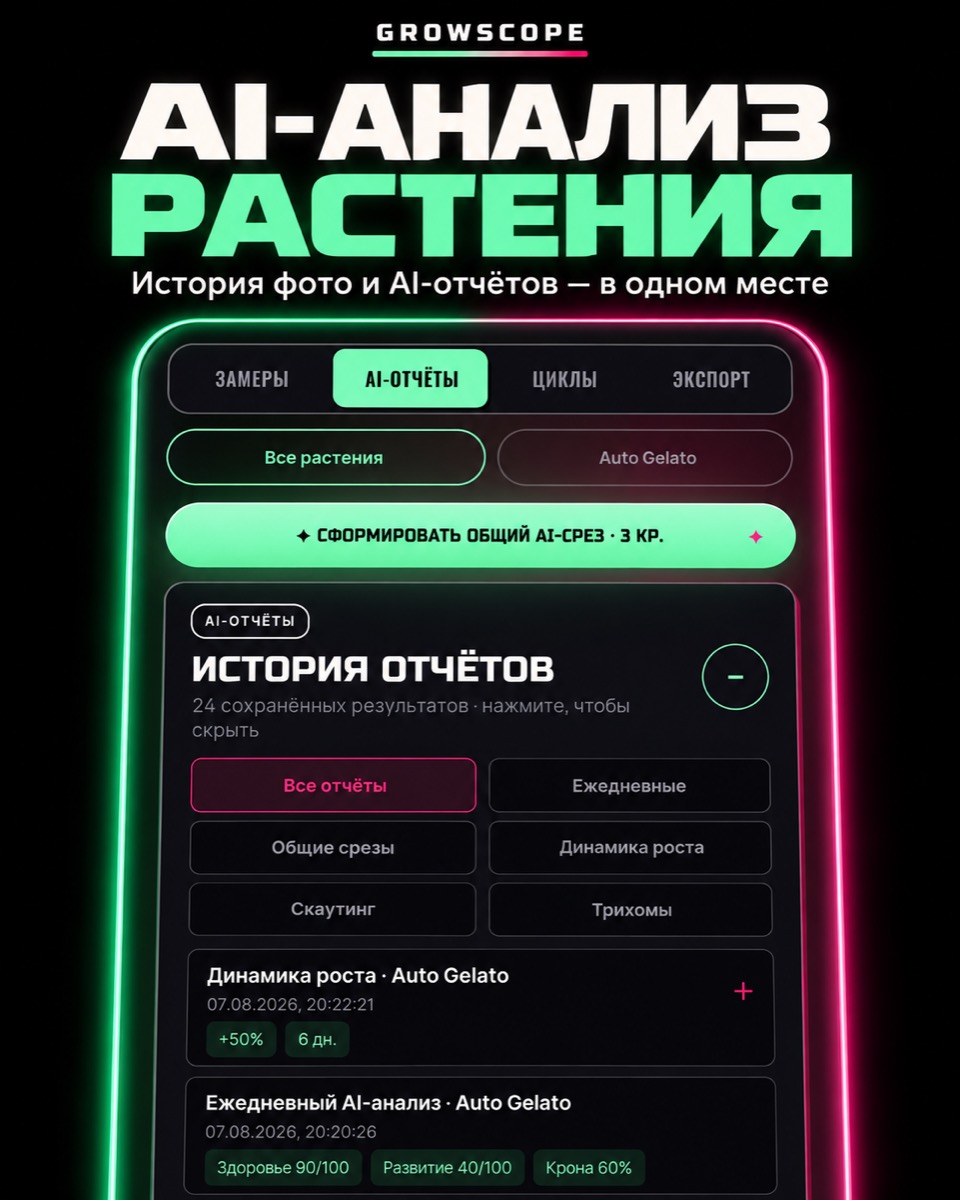
GrowScope sends your photos and the relevant plant context to an AI model (Anthropic Claude or OpenRouter/Google Gemini, switchable) that separates observation from hypothesis. It won't claim a pest without visible evidence, and it adjusts its conservatism depending on whether you're growing an autoflower or a photoperiod plant. You get a health score, development score, canopy fill percentage, and a written assessment.
How it works
- Upload up to four photos at once — the AI reads them together, not one at a time.
- The model receives the plant's strain, age, substrate, the last 21 days of its daily plan, and EC/pH history as context for the analysis.
- The system prompt explicitly separates observation from hypothesis — the model reports what it sees and what it suspects, never blending them.
- The trichome tracker estimates the harvest window from macro photos. If the photo lacks the clarity needed (poor focus, scale, or lighting), the model asks for a better image instead of guessing.
- Pest scouting screens for three specific issues — spider mites, thrips, and powdery mildew — as a cautious visual screening, not a lab diagnosis.
What you get
You know whether what you're seeing is a problem, normal, or not yet clear — and if the photo isn't good enough, the AI tells you that instead of inventing certainty.
Frequently asked questions
Does the AI guarantee a correct diagnosis?
No. This is a visual screening tool, not a lab test. The model separates observation from hypothesis and asks for better photos when the evidence is insufficient — but it can be wrong. GrowScope's deterministic safety rules (on feeding, for example) always have the final say on anything actionable.
What happens to my photos when I request an analysis?
Photos are sent as-is (EXIF data intact) to the selected AI provider — Anthropic Claude or OpenRouter/Google Gemini. This is the only reason photos leave GrowScope's server. They are not used for model training or resold.
Can the AI identify every pest or disease?
No. Pest scouting is limited to spider mites, thrips, and powdery mildew. It is described in-product as cautious visual screening, not a lab diagnosis. Other issues may be flagged as observations but the model will not name a pest or pathogen without visible evidence.
What does the trichome tracker actually tell me?
It predicts a harvest window based on macro photos of trichomes. If the image is blurry, poorly lit, or at the wrong magnification, the model will explicitly ask you to reshoot rather than produce an unreliable estimate.