Stop guessing where the light actually lands.
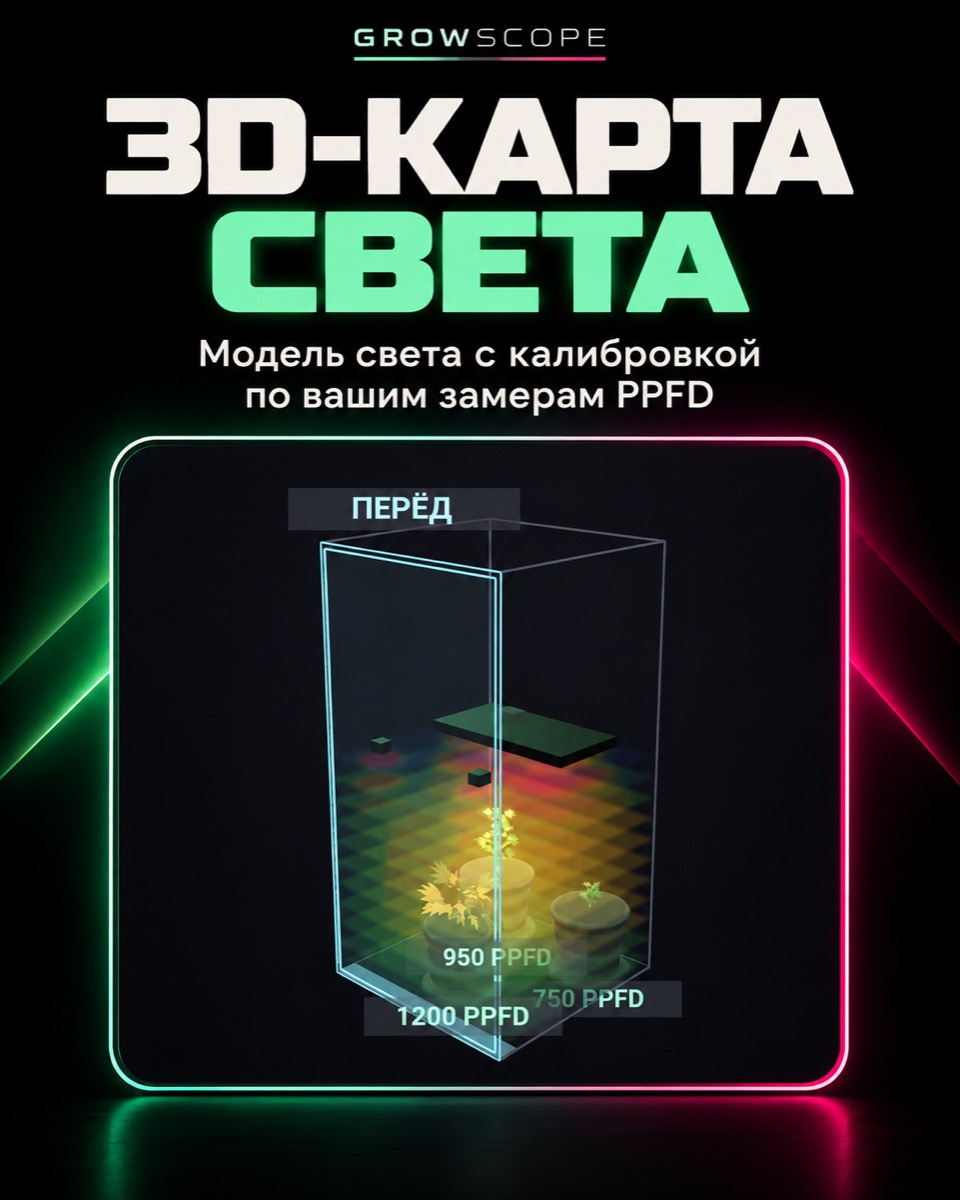
GrowScope builds a physically modeled 3D map of light distribution in your grow space using Lambertian source modeling and mirror-reflected wall/ceiling/floor contributions with material-specific reflectance constants. Your own PPFD readings calibrate the model through logarithmic 3D IDW interpolation — this is not a wattage lookup table.
The problem
A lamp's wattage or a manufacturer's PAR map tells you what the light does in a reflective sphere or an empty tent — not in your actual space with your actual walls, your actual plant placement, and your actual fixture height. Hotspots, drop-offs, and overlapping beams are invisible until the plant reacts, and by then it's too late.
Why it's hard to solve alone
Light is the single largest controllable yield driver. A 15% PPFD difference across the canopy — typical in unmeasured setups — translates directly into a 15% yield gap between your best and worst plant. Knowing where the light actually lands lets you fix it before it costs you grams.
How GrowScope helps
The 3D light map uses a Lambertian source model (I(θ) = I₀ · cosᵐ(θ)) and mirror-reflection contributions from walls, ceiling, and floor, each with material-specific constants (mylar 0.94, white 0.8, tracing paper 0.35, black 0.05, glass 0.15). Your real PPFD measurements calibrate the map through 3D IDW interpolation in logarithmic space. A deterministic fixture optimizer suggests placement adjustments — AI is used only to weight the optimizer's goals, never for the physics calculation itself.
How it works
- A physically modeled light map computes intensity distribution using a Lambertian source model with beam-angle exponent m and mirror reflections from all surfaces.
- Wall, ceiling, and floor reflectivity uses material-specific constants — mylar (0.94), white (0.80), tracing paper (0.35), black (0.05), glass (0.15).
- Your own PPFD readings calibrate the model through 3D inverse-distance-weighted interpolation in logarithmic space.
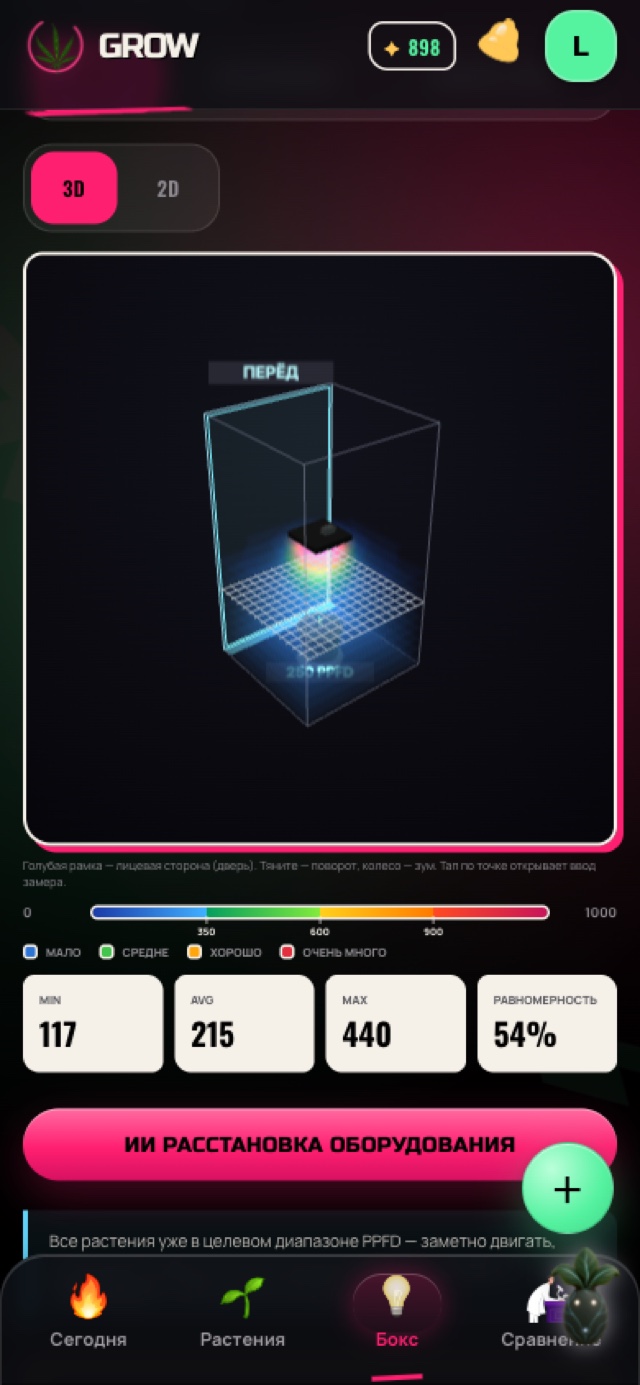
- A deterministic fixture placement optimizer suggests layout changes — AI is used only to weight which goals matter most, not to compute light physics.
- Light fixtures are categorized by general type (quantum board, bar, COB, custom) with a free-text name field — there is no built-in catalog of specific commercial models.
In the app
What you get
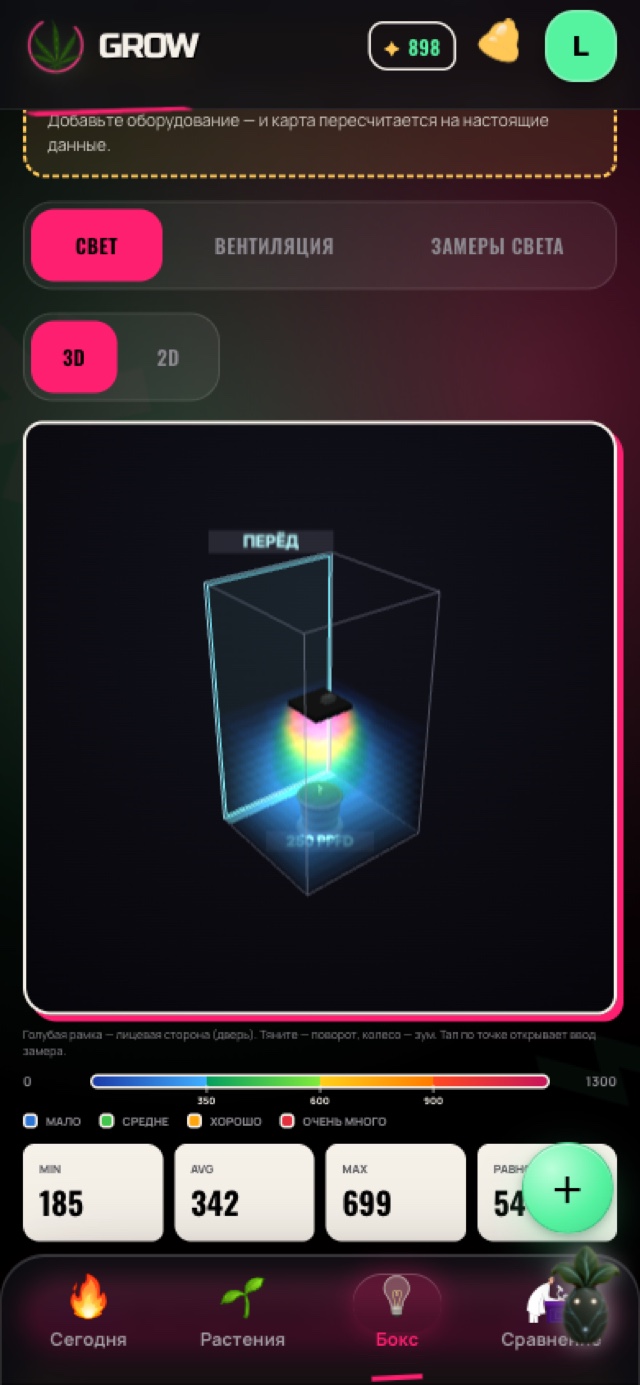
You see exactly where light is strong, where it drops off, and what to move — grounded in physics and your own measurements, not a lamp spec sheet.
Frequently asked questions
Does the light map include a catalog of specific lamp models?
No. Fixtures are categorized by general type — quantum board, bar, COB, or custom — and you enter the name yourself. GrowScope does not ship with profiles for specific commercial lamp models.
How does calibration work?
You take PPFD readings at points in your grow space and enter them. The model uses 3D inverse-distance-weighted interpolation in logarithmic space to calibrate the physical light map to your real measurements — so the map reflects your actual setup, not a theoretical ideal.
Does the fixture optimizer use AI?
Only to weight the optimization goals — for example, deciding which part of the canopy to prioritize. The physics calculation — Lambertian distribution, reflection modeling, PPFD interpolation — is entirely deterministic.
What does the wall reflectivity setting do?
The model accounts for light bouncing off walls, ceiling, and floor using mirror-reflection math with material-specific reflectance constants. Changing the material from white (0.80) to mylar (0.94) recalculates the entire map based on the new reflectivity values.