How to Measure PPFD at Home
A proper quantum sensor costs more than many growers spend on their entire light setup. Fortunately, the camera in your pocket can get close enough for practical decisions — close enough to know whether a corner of the tent is starved for light or whether a new fixture actually delivers what the box promised.
What a real quantum sensor does (and why it's expensive)
A quantum sensor uses a filtered photodiode calibrated to count photons evenly across the entire PAR spectrum, ignoring how bright those photons look to a human. The filter alone is precision optical hardware, and that is what drives the cost into the hundreds of dollars. For a commercial greenhouse where light uniformity directly translates to revenue per square metre, the investment makes sense. For a home grower trying to dial in a single tent, it is often overkill.
Camera-based phone apps as a practical alternative
Several apps use the phone's camera sensor rather than the ambient-light sensor, and with good reason: the camera sees a broader spectral range and can be corrected with a simple diffuser — a small piece of white printer paper held over the lens — to average incoming light more like a cosine-corrected sensor. Independent testing by horticultural researchers has found that camera-based apps can stay within about twenty percent of a reference quantum sensor, which is more than adequate for deciding whether your light needs to move six inches closer or whether a corner needs a supplemental panel.
How to take a reading that means something
Hold the phone at the exact height of the canopy, with the diffuser in place, and point it straight up at the light source. Take readings at multiple points across the grow area — centre, mid-radius, and corners — because a single number from directly under the fixture is misleading. Write down or photograph each spot's reading. The pattern matters more than any individual value: a steep drop-off toward the edges tells you the light's footprint is too narrow for your space, and a lopsided distribution tells you a fixture is off-centre or tilted.
What to avoid
Apps that rely on the phone's built-in ambient-light sensor are far less reliable. That sensor was designed to adjust screen brightness based on how bright a room looks, not to count photons, and its spectral sensitivity curve is nothing like a quantum sensor's. Readings from these apps can be off by fifty percent or more depending on the light spectrum. If the app does not ask you to cover the lens with a diffuser and hold the phone face-up at canopy level, it is probably using the wrong sensor for the job.
How GrowScope helps
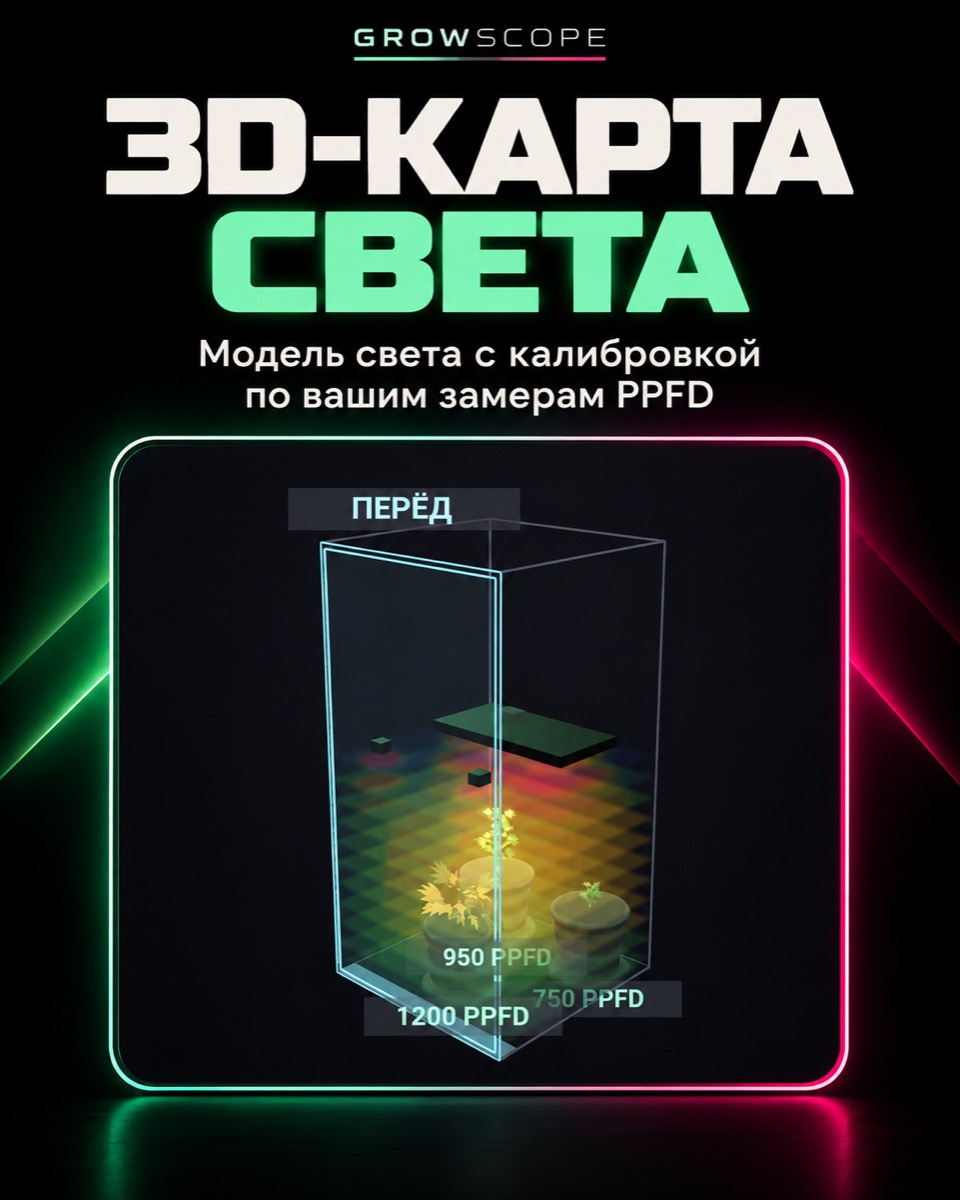
Once you have a phone-based PPFD reading, GrowScope's light monitoring uses it to calibrate a full 3D map of your grow space — turning a handful of manual readings into a picture of where the light is actually strong or weak across the whole canopy, not just at the one spot you measured.
Key takeaway
A smartphone camera with a white-paper diffuser can estimate PPFD within about 20% of a real quantum sensor — good enough for positioning decisions.